What professional emergency roof tarping actually does, why a DIY tarp often fails, and how it supports your insurance claim.
After a storm tears shingles off your roof, the clock starts. Every hour that exposed decking sits open to the sky is an hour it can take on water. Emergency tarping is the bridge between the damage and the permanent repair, and done right it protects both your home and your insurance claim. Done wrong, it can actually make the water intrusion worse.
A lot of homeowners assume a tarp is a tarp. It is not. There is a real difference between a plastic sheet weighted down with bricks and a professionally anchored cover that sheds water the way your roof is supposed to. Here is what proper tarping involves and why it is worth doing correctly.
What Emergency Tarping Actually Does
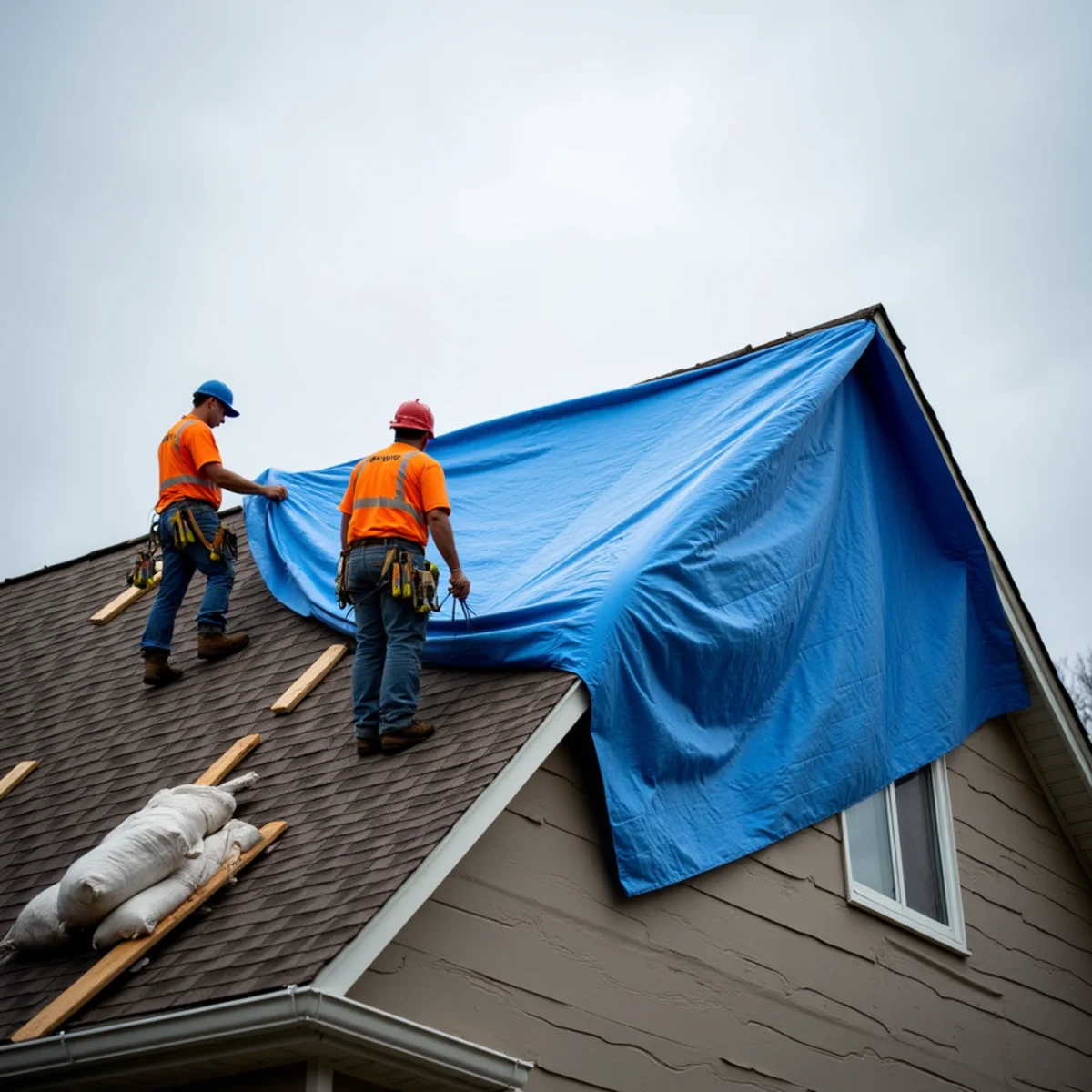
A properly installed tarp does three jobs. It keeps rain out of the decking and attic, it prevents wind from peeling back more shingles at the damaged edge, and it holds the situation stable while your claim is processed and materials are ordered. That stability is the whole point: it stops a contained problem from spreading across the rest of the roof and into your ceilings.
- Keeps water out of exposed decking, insulation, and drywall.
- Stops wind from lifting shingles adjacent to the damage.
- Buys time for a proper claim and repair without ongoing losses.
- Prevents mold by keeping interior materials dry, per EPA 24 to 48 hour guidance.
Why DIY Tarps Often Fail
The most common tarp mistake is fastening it flat over the peak so water pools or runs underneath. A tarp needs to be run up and over the ridge and anchored so water sheds downhill without tracking under the surrounding shingles. Weighing a tarp down with cinder blocks does nothing in a 40 mph gust, and unanchored edges flap until they tear or lift. There is also the plain safety issue: most roof falls happen to homeowners trying to fix or cover a roof themselves.
Our crews anchor tarps into solid framing and lap them correctly so the cover works with gravity, not against it. If your home has been hit, our emergency roof tarping service gets a real barrier in place fast and safely.
How Tarping Strengthens Your Insurance Claim
Most homeowner policies require you to take reasonable steps to prevent further damage after a loss. This is called your duty to mitigate. If you leave a roof open and the interior floods over the following week, an insurer can argue that the added damage was preventable. A documented, professional tarp shows you acted responsibly and preserved the property.
- Photograph the damage before the tarp goes on.
- Keep the invoice for the tarping work, it is often reimbursable.
- Photograph the finished tarp as proof of mitigation.
- Note the date, and any National Weather Service Chicago warnings tied to the storm.
We coordinate this documentation as part of the job. When it is time to file, our team can align the tarp record with the rest of your file through our roof insurance claims support. Remember that your deductible remains your responsibility under Indiana law, and any legitimate roofer will be upfront about that.
How Long a Tarp Should Stay On
A quality tarp is a temporary measure, not a season-long fix. It should hold for a few weeks while the claim is settled and materials arrive, but ultraviolet light and repeated wind will degrade any tarp over time. The goal is always to move to a permanent repair or replacement as soon as the process allows. Homeowners across Chesterton roofing and nearby towns rely on us to keep that timeline tight.
The Bottom Line
Emergency tarping is not busywork, it is damage control that protects your decking, your ceilings, and your claim all at once. A professional, anchored, well-documented tarp does what a weighted-down sheet cannot. If a storm has opened up your roof anywhere in Hobart roofing service areas or beyond, call Anto Roof Replacement & Repair at (855) 705-1940 and we will get a proper cover on before the next rain finds its way in.
What Materials Make a Tarp Actually Hold Through a Northern Indiana Winter?
The blue poly tarp from the hardware store is built to cover a woodpile, not to survive weeks of freeze-thaw and lake-effect wind. When homeowners ask why a professional cover costs more than a sheet from the shelf, the answer is in the materials and how they are fastened. A tarp that has to hold through a Porter County January is a different animal than one thrown over a leak in July.
- Heavier reinforced poly or woven fabric that resists tearing at the grommets when the wind loads it.
- Furring strips screwed through the tarp edges into solid framing, so the anchor is mechanical, not weighted.
- Sandbags only as a supplement at seams, never as the primary hold on a pitched roof.
- Enough length to run over the ridge and down the opposite slope, so wind cannot get underneath and balloon it.
Why Winter Tarping Is Its Own Job
Cold changes everything about a temporary cover. Poly stiffens and cracks in deep cold, sealant tapes lose their grab, and a tarp that traps snow load can pond and freeze into a heavy sheet that pulls its own anchors out. In freeze-thaw weather a tarp also has to shed meltwater cleanly or it becomes a bathtub. This is part of why a tarp is a bridge measured in weeks, and why we watch the Chesterton roofing forecast when we set one so it comes off before it fails.
A tarp fastened with bricks is a lawsuit against gravity. In a lake-effect gust it always loses.
There is also a documentation angle homeowners overlook: photograph the fasteners and the framing they bite into, not just the finished blue sheet. That detail shows an adjuster the cover was a real mitigation effort. We fold that into every emergency roof tarping job so the record is airtight before the permanent repair begins.
When Can You Tarp It Yourself, and When Should You Call?
Not every tarp needs a professional, and it is fair to ask where the honest line sits. The deciding factors are the pitch of the roof, the height off the ground, the size of the opening, and the weather still in the forecast. A tarp is only worth doing yourself if you can do it without getting hurt and without making the leak worse.
- The damage sits on a low, walkable slope you can reach from a stable ladder without stepping onto the roof itself.
- The opening is small and the sky is clear, giving you daylight and dry conditions to work in.
- You have proper reinforced material and a way to anchor the edges into solid framing, not bricks and hope.
- No more rain or wind is moving through the area for the next several hours.
Flip any of those conditions and the job belongs to a professional. A steep or second-story slope makes a fall the real hazard, not the leak. Rain or wind still moving through on the National Weather Service Chicago forecast turns a ladder into a bad idea. And a large opening, or one near a chimney or valley, needs anchoring and lapping a weighted sheet cannot match. In those cases emergency roof repair crews carry the fall protection and the know-how to cover the roof without adding an injury to the loss, which is why homeowners around Valparaiso service areas often find the safe DIY window is narrower than it looks from the driveway.
Common Misconceptions About Emergency Roof Tarping
Because tarping looks simple from the ground, it collects more than its share of bad assumptions. Each one leads a homeowner to either skip a step that matters or trust a cover that will not hold, so it is worth clearing them up before the sky opens.
- Misconception: a tarp is a repair. Reality: it is a temporary bridge measured in weeks, meant only to stop water while the claim and materials come together.
- Misconception: more weight means a better hold. Reality: bricks and sandbags do little in a real gust; a tarp holds when it is fastened into solid framing and run over the ridge.
- Misconception: insurance will not touch tarping costs. Reality: most policies cover reasonable steps to prevent further damage, so keep the invoice and photos, though your deductible stays yours under Indiana law.
- Misconception: any tarp will do. Reality: hardware-store poly cracks in the cold and shreds in lake-effect wind, which is a different job than covering a woodpile.
A tarp is not the finish line. It is the guardrail that keeps a bad night from becoming a gutted attic.
Handled right, a tarp protects your decking and your claim at once, then gives way to a real fix. If the opening is large or the weather is still moving, a professional storm damage roof restoration crew covers it safely and documents the mitigation. Homeowners across Porter County service areas who understand what a tarp is, and is not, use it as the stopgap it was meant to be.