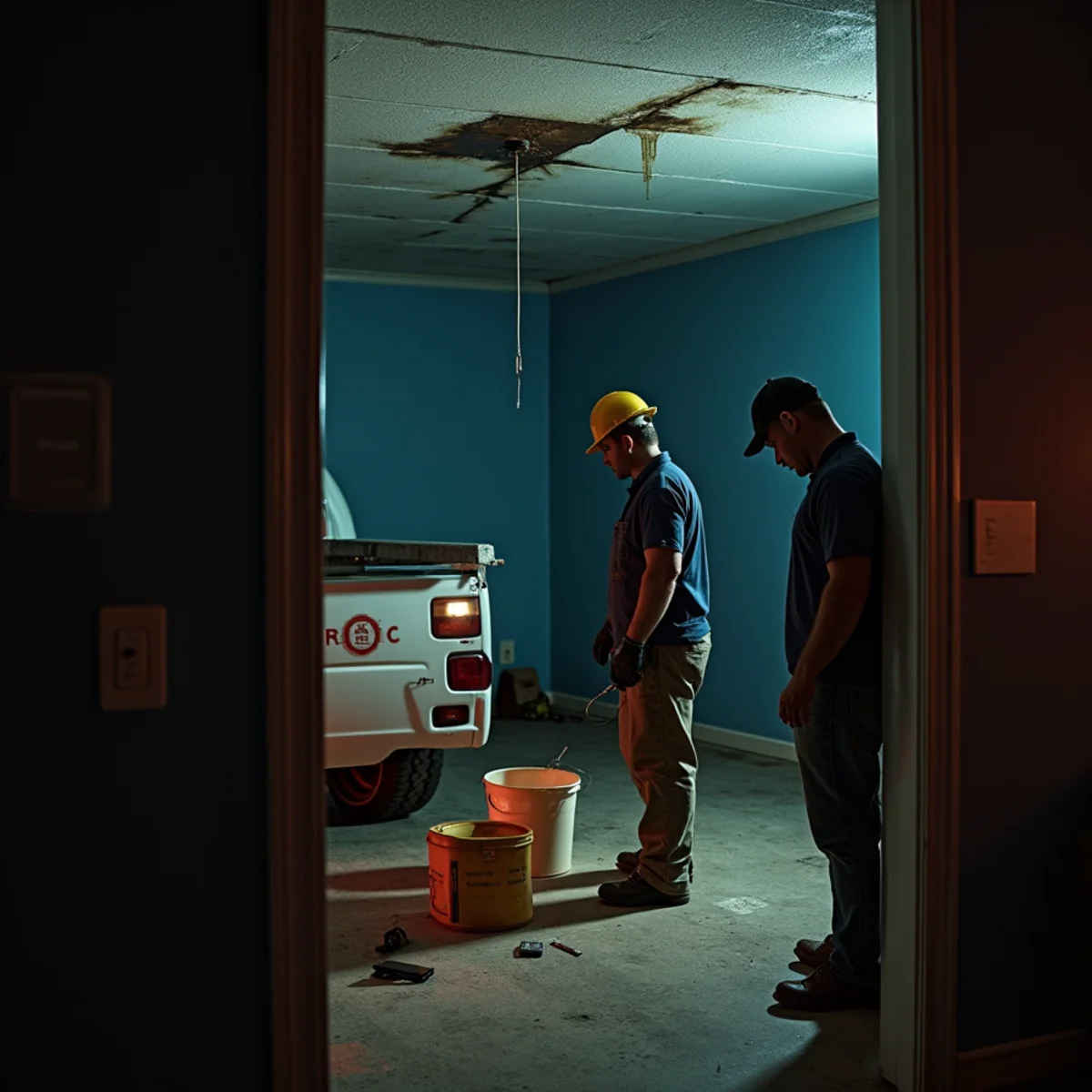
A clear middle-of-the-night action plan for a roof leak, from containing water to when to call a roofer in Valparaiso and Portage.
A roof leak never picks a convenient time. When you wake at 2 AM to the sound of dripping or a spreading brown stain on the ceiling, it is easy to panic. You do not need to. A leak at night is manageable if you work through a short list of steps in the right order. The point is to protect your belongings, control the water, and set yourself up for a proper repair once it is light out.
Here is the exact plan we give homeowners who call our line in the small hours. Most of it takes only a few minutes and needs nothing more than a bucket, a screwdriver, and a phone.
First: Protect What Is Below
Water follows gravity and it will ruin whatever is under the drip. Move furniture, rugs, and electronics out of the path. Lay down a plastic sheet or garbage bags and set a bucket to catch the water. If the drip is spreading across the ceiling, put down a wide catch area because leaks rarely come straight down.
- Move electronics and furniture away from the drip.
- Cover what you cannot move with plastic sheeting.
- Place buckets, and put a towel in the bottom to cut the splashing noise.
- Keep a phone or flashlight handy, not a candle near wet drywall.
Second: Relieve a Bulging Ceiling
A ceiling that is sagging and holding a pocket of water is a real hazard. It can give way all at once and take down drywall, insulation, and light fixtures. Put a bucket underneath, then use a screwdriver to poke a small hole at the lowest point of the bulge to let the water drain in a controlled stream. It feels wrong to poke a hole in your ceiling, but a small drain hole is far cheaper to patch than a collapsed ceiling.
Third: Shut Off Power If Water Is Near Fixtures
If water is anywhere near ceiling lights or electrical boxes, turn off power to that room at the breaker. Do not stand in water to reach a switch. Electricity and water together are the most dangerous part of a nighttime leak, and this single step prevents most of the worst outcomes.
Fourth: Find the Source If You Safely Can
If you have attic access and it is safe to get there, a flashlight can help you spot where water is entering. Leaks often travel along rafters and decking before dropping through the ceiling, so the wet spot inside is not always under the actual roof breach. Do not go on the roof in the dark or the rain. That is a job for daylight and a professional. When you do need hands-on help, our roof leak repair team can locate the true source without guesswork.
Fifth: Call for Emergency Help When It Escalates
Some leaks are a slow drip you can manage until morning. Others are a steady flow that no bucket will keep up with. When water is coming in faster than you can contain it, or a large section of ceiling is failing, that is the moment for 24/7 emergency roof repair. We serve homeowners across Valparaiso roofing and nearby communities around the clock, and a call to (855) 705-1940 gets a plan in motion right away.
What Happens at First Light
Once it is safe, a roofer can get on the roof, find the breach, and either make a lasting repair or install a temporary tarp to hold until materials arrive. The EPA recommends drying wet materials within 24 to 48 hours, so the sooner airflow reaches soaked drywall and insulation the better your odds of avoiding mold. Homeowners throughout Portage roofing service areas count on us to move quickly on that window.
The Bottom Line
A 2 AM leak is a test of order, not strength. Protect your belongings, relieve any bulging ceiling, cut power near water, find the source only if it is safe, and call for emergency help when the water outpaces your buckets. Keep our number on the fridge so you are not searching for it half-asleep: Anto Roof Replacement & Repair, (855) 705-1940. We answer when the rain does not wait for morning.
How Do You Tell a Roof Leak From Condensation at Night?
Not every drip at 2 AM is a roof breach. In an Indiana winter especially, a cold attic and warm indoor air can produce condensation that mimics a leak, dripping off nail tips and rafters and staining the ceiling in ways that look identical from below. Chasing the wrong problem wastes the hours you have before daylight, so it helps to read the clues before you assume the roof failed.
- A leak usually tracks with rain or snowmelt; condensation shows up on cold, clear nights with no precipitation.
- Leaks tend to drip from a consistent point; condensation dampens a broad area and beads on nail heads across the decking.
- Frost or a sheen on the underside of the decking in the morning points to condensation and a ventilation problem, not a hole.
- A clean water stain with a defined ring is more often a true roof leak.
The Overnight Kit Worth Keeping
The homeowners who handle a nighttime leak calmly are the ones who staged a few things ahead of time. A dedicated leak kit means you are not hunting for supplies half-asleep while water spreads. Keep it near the attic hatch, not buried in the garage.
- A five-gallon bucket, a roll of plastic sheeting, and a sleeve of contractor bags.
- A headlamp so both hands stay free on the ladder to the attic.
- A pointed screwdriver taped to the bucket handle for relieving a bulge.
- A note card with (855) 705-1940 and your policy number.
If the morning inspection points to condensation rather than a breach, the fix is airflow and sealing, not shingles. Persistent attic moisture that keeps staining ceilings is worth an assessment alongside any roof leak repair work, and homeowners around Portage roofing service areas often find the two problems travel together after a hard freeze.
What a Small Leak Actually Costs If You Let It Ride
It is tempting to empty the bucket each morning and tell yourself the drip is minor. The trouble is that a roof leak does not hold its size or its price. Water that finds a way in keeps working, and the repair that would have been a modest fix in week one becomes something very different by month three.
- Week one: a small active leak, source found and sealed, is often a minor repair in the 150 to 600 dollar planning-benchmark range.
- Weeks two to four: soaked decking and insulation push the job into moderate-repair territory, a 600 to 2,500 dollar range, as materials have to be dried or replaced.
- Beyond a month: persistent moisture invites mold, stained drywall, and rotting framing, none of which a bucket touches and all of which multiply the bill.
- Ignored long enough, a repairable leak becomes a decking-and-structure problem that starts to compete with the cost of a section replacement.
The EPA advises drying wet materials within 24 to 48 hours, and that window is really a cost window as much as a mold window. Catching the source early with a focused roof repair keeps you in the cheapest tier of the whole progression. Homeowners around Chesterton service areas who treat a small overnight drip as urgent, not merely annoying, are the ones who never meet the expensive end of that list.
What to Ask the Roofer When Daylight Comes
Once the sun is up and a crew can safely get on the roof, the overnight scramble turns into a decision. The questions you ask in those first minutes shape whether you get a lasting fix or a patch that fails by the next storm. You do not need to be an expert; you just need to ask the right things and listen for straight answers.
- Where is the actual entry point, and how did you trace it? Water travels along rafters and decking, so the stain rarely sits under the breach.
- Is this a repair or the start of a bigger problem? Ask whether the decking underneath is wet or rotted, and to see photos.
- How will you dry what is already soaked? The EPA advises drying wet materials within 24 to 48 hours to head off mold.
- Is a permanent fix possible today, or do we need a documented tarp as a bridge until materials arrive?
- What will you put in writing, itemized, before any work begins?
A roofer who answers these plainly, shows you the source, and photographs the wet decking is one worth trusting. If the trace turns up hidden saturation, a focused storm damage roof restoration scope beats a quick surface patch. Homeowners across Porter County service areas who ask these questions at first light rarely see the same leak return the following season.